


 Complete Your
Collection
Complete Your
Collection


 Secure Checkout
 30-Day Guarantee







The dust on top of your blinds is genuinely impressive. Run a fingertip along the top edge of a vertical blind that's been hanging since 2022 and you'll see what we mean. That's a long-term build-up of pet dander, dead skin, kitchen grease, and outdoor pollutants that's been quietly settling for years — and a feather duster waved at it just rearranges the problem.
The good news: blinds are genuinely simple to clean once you know which method to use for which material. The bad news: there are at least five materials your blinds could be made of, and the wrong cleaning method will ruin most of them.
Here's the proper UK guide for vertical and Venetian blinds.
Identify your blinds first
The cleaning method depends entirely on what they're made of. Look at a slat or vane and check:
- Plastic / PVC Venetians. Lightweight, slightly flexible. Most affordable supermarket and Wilko Venetians.
- Aluminium Venetians. Thin, light, slightly cool to the touch, can dent if pushed hard. Very common in UK rentals.
- Wooden Venetians. Often "real wood" or "faux wood". Faux wood is dense plastic moulded to look like wood. Real wood is lighter and shows grain when wet.
- Fabric verticals. The standard UK office and lounge blind. Woven polyester, sometimes with a UV coating.
- Plastic / PVC verticals. Less common, but exist. Wipe-clean by design.
- Roman or roller blinds (not technically vertical or Venetian, but worth mentioning). Need different treatment again — we'll add a section.
If you genuinely can't tell what they're made of, run a damp cloth on a hidden corner first. If the colour changes, comes off, or the slat warps, stop — you've got something water-sensitive (real wood or some coated fabrics).
How to clean Venetian blinds (Plastic, PVC, or Aluminium)
The most satisfying clean. Genuinely transformative if they haven't been washed in years.
Step 1 — Dry-dust first
Skipping this step is the #1 mistake. If you start wet on dusty blinds, you create mud that smears across every slat and is much harder to remove than dry dust.
Two ways to dust effectively:
- Microfibre dusting glove — the fastest method. Tilt the slats fully open, run your gloved hand along the entire length of each slat. Both sides in one pass with practice. Our Dusting Gloves are sized for this exact job.
- Soft brush attachment on a vacuum — close the slats fully, run the brush attachment top to bottom on one side, then tilt the slats the other way and repeat. Quieter than a glove for sensitive ears.
Dust both sides. The side facing the room collects pet dander and skin; the side facing the window collects condensation residue and pollen. Both are real.
Step 2 — Mix a cleaning solution
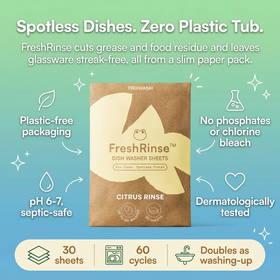
For plastic and PVC: warm water + a few drops of washing-up liquid in a bowl. Half a sheet of our FreshRinse dishwasher sheet dissolved in 500ml warm water works well.
For aluminium: same as above, with a teaspoon of white vinegar added. Vinegar dissolves the slight oxidation film that builds up on aluminium and helps avoid streaks.
For polished wood: don't use water-based solutions. Skip to the wood section below.
Step 3 — Wipe each slat with a damp cloth
A microfibre cloth dipped in the solution, wrung out so it's damp but not dripping. Tilt the slats fully open (horizontal). Hold the slat steady with one hand while wiping with the other, working from the wall outwards.
Wipe one side, tilt the slats the other way, wipe the other side. About 30 seconds per slat for the satisfying clean. The water in the bowl will turn grey within 5 minutes — this is normal and shows the method is working. Replace the water when it's noticeably dirty.
Step 4 — Dry with a clean microfibre
Don't leave slats wet. Water spots on aluminium and PVC are surprisingly stubborn once they dry. A quick dry pass with a separate clean microfibre after the wash pass eliminates streaks and prevents water marks.
Step 5 — Tilt and check
Tilt the slats slowly through their full range while looking at them. If you see streaks at certain angles, those are the spots that need a re-wipe.
How to clean wooden Venetian blinds
Wood is the most fragile material in the blinds category. Water warps, lifts veneer, and lifts grain. Don't soak.
- Dust dry first with a microfibre glove or vacuum brush attachment
- Wipe each slat with a very slightly damp microfibre cloth — barely damp, not wet. If your cloth leaves any visible wetness on the slat, it's too wet
- Dry immediately with a separate clean microfibre cloth, working in the direction of the grain
- For grease build-up (kitchen blinds): add a teaspoon of washing-up liquid to a small amount of water, dip the cloth, wring out almost completely, wipe, dry immediately
- Once a year: apply a tiny amount of furniture polish or beeswax to restore the finish. Apply to the cloth, not the slats; buff in
Faux wood (plastic moulded to look like wood) is fully waterproof and can be treated like plastic Venetians. The give-away is that faux wood is heavier and the "wood" texture is identical on every slat.
How to clean vertical blinds (Fabric)
The most common UK blind, the trickiest to clean because you can't easily move the vanes for washing.
Step 1 — Vacuum thoroughly
Soft brush attachment on the vacuum. Close the blinds fully so the vanes overlap. Vacuum top to bottom in long strokes — both sides. This removes the dust that would otherwise turn into mud when you wet-clean.
Step 2 — Treat stains with a damp cloth
A microfibre cloth dipped in lukewarm water + a few drops of washing-up liquid, wrung out well. Dab (don't rub) at any visible stains. For pet stains or food splashes, gentle pressure works; aggressive rubbing pulls the fabric weave open.
For old set-in stains: a paste of bicarbonate of soda + water applied to the stain, left 15 minutes, then dabbed off with a damp cloth.
Step 3 — The deep-clean option (most fabric verticals)
This is the option most UK households don't know about: most fabric vertical blinds can be removed and washed in the bath. Check the rail — almost all vertical blind vanes have a hook at the top that lifts off the rail with a small twist.
- Lift each vane off the rail individually
- Roll each vane loosely (don't fold — folding creases permanently)
- Fill the bath with lukewarm water + half a normal dose of gentle detergent (or a quarter of a laundry sheet)
- Submerge the rolled vanes, gently agitate with hands for 30 seconds, leave 10 minutes
- Drain, refill with clean water for a rinse, repeat the rinse
- Lift each vane, let drip-dry over the bath
- Hang back on the rail while still slightly damp — the weight of the bottom chain pulls them straight as they dry
This is the proper deep clean and yields almost-new vanes. Two caveats: not all fabric verticals are washable (check the label or any documentation that came with them); and don't ever put them in the washing machine — the agitation creases them permanently.
Step 4 — Reset the alignment
Vertical blinds often hang slightly misaligned after cleaning. Open and close them through their full range a few times after cleaning to reset the alignment, and make sure the chain at the bottom is fully connected.
How to clean roller and Roman blinds (briefly)
Different category but worth covering:
- Roller blinds, fabric: vacuum with brush attachment. Spot-treat stains with diluted detergent on a damp cloth, dab don't rub. Don't try to wash these — they're glued to the bottom bar and you'll wreck them.
- Roller blinds, PVC (blackout style): wipe with damp cloth + mild detergent, dry with microfibre. Easy.
- Roman blinds: usually not washable. Vacuum thoroughly, spot-treat stains. For a deep clean, professional dry cleaning is the only safe option — ~£20–£40 per blind in the UK.
Comparison: methods by blind type
| Blind type | Dust method | Wet clean method | Deep clean |
|---|---|---|---|
| Plastic / PVC Venetian | Glove or vacuum | Damp microfibre + soapy water | Lift off, soak in bath |
| Aluminium Venetian | Glove or vacuum | Damp microfibre + soapy water + vinegar | Lift off, soak in bath, dry immediately |
| Wooden Venetian (real) | Glove or vacuum | Barely-damp microfibre, dry immediately | Avoid — spot clean only |
| Faux wood Venetian | Glove or vacuum | Damp microfibre + soapy water | Lift off, soak in bath |
| Fabric vertical | Vacuum brush attachment | Dab stains with damp cloth + detergent | Lift vanes, soak in bath, drip dry |
| PVC vertical | Vacuum or glove | Damp microfibre + soapy water | Lift off, soak in bath |
How often to clean blinds
- Dry dust: every 2–4 weeks — this is the maintenance frequency that prevents the big build-up. 5 minutes per window.
- Wet clean / damp wipe: every 2–3 months in lounges and bedrooms, monthly in kitchens (grease).
- Deep clean (bath soak): annually, or when they look visibly grimy despite the regular routine.
The harsh truth: most UK households dust their blinds once a year (when they notice the dust line on top), and deep-clean never. The grime you can see is only the top layer of what's actually there.
Common blind-cleaning mistakes
- Skipping the dry-dust step. Wet on dusty = mud smear. Always dust first.
- Using too much water on wood. Real wood warps. Barely damp, dry immediately.
- Putting fabric vanes in the washing machine. Creases them permanently. Soak in the bath only.
- Folding fabric vanes when removing them. Creates permanent crease lines. Roll loosely instead.
- Using furniture polish on plastic or aluminium. Leaves a sticky surface that attracts dust faster.
- Bleach on coloured fabric vanes. Bleaches the dye irrecoverably.
- Using a feather duster. Just rearranges dust into the air, doesn't capture it. Microfibre or vacuum — feather dusters belong in 1985.
- Aggressively scrubbing aluminium. Scratches the finish and damages the powder coating. Light wipe only.
- Not vacuuming the headrail / cord mechanism. The most-ignored bit. Dust accumulates here and shortens the lifespan of the mechanism.
Frequently asked questions
How do you clean Venetian blinds without taking them down?
Tilt the slats fully open, dust both sides with a microfibre glove or vacuum brush attachment, then wipe each slat with a damp microfibre cloth dipped in soapy water (a few drops of washing-up liquid in warm water). Dry with a clean microfibre afterwards to prevent water spots. Works for plastic, PVC, faux wood and aluminium blinds.
How do you clean fabric vertical blinds?
Vacuum with the soft brush attachment thoroughly. Spot-treat visible stains with a damp microfibre cloth and a few drops of washing-up liquid. For a deep clean, lift each vane off the rail, roll loosely, soak in the bath with mild detergent for 10 minutes, rinse, hang back to drip-dry. Never put fabric vertical blind vanes in the washing machine — the agitation creases them permanently.
Can you wash blinds in the washing machine?
No, never. The agitation of the machine creates permanent creases in fabric vanes and damages the construction of all other types. The bath-soak method works for most washable blinds.
How do you clean wooden Venetian blinds without warping them?
Dust dry first. Then wipe each slat with a very slightly damp microfibre cloth — barely damp, not wet. Dry immediately with a separate clean microfibre, working in the direction of the wood grain. Never soak wooden blinds in water; even brief water exposure warps them or lifts the finish.
What's the fastest way to clean Venetian blinds?
Microfibre dusting gloves — you can clean both sides of each slat in one pass by running your gloved hand along the slat. A full set of Venetian blinds takes about 5 minutes with gloves vs 20 minutes with a cloth.
How do you remove dust from blinds without making a mess?
Close the slats fully and vacuum top to bottom on one side with a soft brush attachment, then tilt the slats the opposite way and repeat. The vacuum captures the dust rather than spreading it. A microfibre glove also works — the static charge holds dust to the glove rather than dispersing it into the air.
How do I clean kitchen blinds that have grease on them?
Grease needs surfactant. Add a teaspoon of washing-up liquid (or half a dishwasher sheet) to warm water, wipe each slat with a damp microfibre, then dry with a clean cloth. Repeat the wash on stubborn slats — one pass usually isn't enough for kitchen grease. For wood, use the minimum water and dry immediately to avoid swelling the slat.
How often should I clean my blinds?
Dry dust every 2–4 weeks, wet wipe every 2–3 months (monthly for kitchen blinds), and deep clean annually. Most UK households dust their blinds once a year and never deep clean — which is why the dust you can see is the tip of a much bigger build-up.
Can I use bleach on blinds?
No on coloured fabric vanes (bleaches dye irrecoverably). No on aluminium or wood (damages the finish). Yes, in tiny diluted amounts, on white plastic or PVC blinds if needed for set stains — but bicarbonate of soda paste usually achieves the same result without the risk.
What's the best cleaner for vertical blinds?
For fabric verticals: vacuum + mild detergent solution for spot stains, plus annual bath soak for deep clean. For PVC verticals: damp microfibre + soapy water, dry with clean microfibre. Avoid commercial blind sprays — most leave a sticky residue that attracts dust faster than before.
Got a blind-cleaning question we haven't covered? Email us — family of three, no support script.


