


 Complete Your
Collection
Complete Your
Collection


 Secure Checkout
 30-Day Guarantee





Wool tumble dryer balls have been on every “eco swap” list for the last five years — replace your dryer sheets, save the planet, soften your towels, reduce drying time, fewer wrinkles. The marketing claims are big. Some are real; some are exaggerated; one is genuinely misleading.
Honest disclosure: TruWash doesn't sell wool dryer balls (yet), so this is a clean editorial review with no horse in the race. Three years of using them at home, plus a proper look at what's documented and what's anecdotal.
The short answer
Yes, wool tumble dryer balls work — for the things they actually do well. They genuinely:
- Reduce drying time (modestly — about 15–25% on heavy loads)
- Reduce static cling on natural-fibre clothes
- Soften towels and cotton (gently, without coating fibres)
- Replace single-use dryer sheets entirely
- Last 1,000+ loads (years for most UK households)
They do not:
- Eliminate static on heavy synthetic loads (fleece, sportswear) — they help but don't fix it
- Add scent on their own (only if you add essential oil)
- Work meaningfully on light loads (under 3kg)
- Magically eliminate wrinkles (the claim that's overcooked the most)
How they actually work
Three mechanisms, all real, but doing different jobs:
1. Mechanical separation
As the dryer spins, the balls bounce around and physically separate clothes that would otherwise tumble in a clump. Better airflow between garments = faster drying and less friction between fabrics. This is the biggest of the three effects.
2. Moisture buffering
Wool is hygroscopic — it absorbs water from the wet clothes and slowly releases it back as the dryer air gets hotter. This keeps the drum air at a more even humidity, which reduces static buildup and slightly accelerates drying overall.
3. Grounding
Wool fibres absorb and dissipate electrical charge as clothes rub against them. This is what reduces static cling. The effect is genuine but modest, especially with synthetic fabrics that can hold a lot of charge.
What we tested at home (informally)
Three years of weekly use in a four-person household. Compared dryer balls (set of 6 New Zealand wool, £12 from John Lewis) against no balls, and against the brand-name dryer sheets (Bounce) we used before. UK Beko heat-pump dryer, mixed loads of cotton, polyester, fleece.
| Test | No balls | Wool balls | Bounce dryer sheets |
|---|---|---|---|
| Drying time, 6kg cotton load | ~75 min | ~60 min | ~72 min |
| Drying time, 5kg fleece + synthetic | ~60 min | ~50 min | ~58 min |
| Static cling, cotton load | Minimal | None | None |
| Static cling, synthetic load | Significant | Moderate | Minimal |
| Towel feel | Slightly stiff | Genuinely soft | Soft but coated |
| Towel absorbency over time | Maintained | Maintained | Reduced over months |
| Wrinkles | Present | Slightly fewer | Slightly fewer |
The fleece-and-synthetic static result is the one that surprised us most — wool balls help, but dryer sheets do beat them on that specific category. For everything else, balls are equivalent or better.
Where wool dryer balls really shine
- Cotton bedding and towels. Faster drying, soft finish, no coating that reduces absorbency over time. This is the use case where wool balls are genuinely superior to dryer sheets.
- Sensitive skin households. No synthetic fragrance, no quaternary ammonium chloride (the active surfactant in dryer sheets that can trigger eczema and irritation).
- Asthma / fragrance-sensitive households. No volatile organic compounds. Genuinely cleaner indoor air.
- Long-term cost. £10–£15 once, lasts 3–5 years. Replaces £5–£8 boxes of dryer sheets every 2 months. ROI is fast.
- Reducing plastic. Dryer sheets are single-use, often non-recyclable, and shed microplastic into your dryer lint. Balls are completely waste-free.
Where they're weaker than dryer sheets
- Heavy synthetic loads. Fleece, polyester sportswear, acrylic jumpers — lots of static charge. Wool balls help but don't fix the worst of it.
- Scent. If you like the smell of branded dryer sheets, balls give you nothing — unless you add essential oil.
- Very small loads. Under 3kg, the balls don't have enough mass moving around to make a noticeable difference. Save them for proper loads.
How to use them properly
Most people throw them in and don't think about it. There are small tweaks that make a real difference:
How many balls?
Three for small loads, six for full loads. More isn't better — past 6, you're just adding weight that the motor has to spin.
Throw them in with the wet clothes from the start
Not halfway through. The balls need to be working the whole cycle to give the time-savings.
For scent: add 3–5 drops of essential oil to one ball every 5–10 loads
Lavender, lemongrass, eucalyptus, citrus. Don't drench the ball — a few drops, then let it sit out of the dryer for 10 minutes so the oil soaks in. Otherwise the oil transfers as wet spots onto clothes for the first run.
For maximum static control: dry your synthetics on a separate cycle
This is the trick that solves the wool-balls-don't-kill-synthetic-static problem. Run cotton/natural-fibre loads with the balls (works great). Run fleece/synthetic loads separately on a shorter cycle, take them out slightly damp, finish on an airer. Less time in the dryer = less charge built up.
Air the balls between loads
Wool balls hold moisture. If you do back-to-back loads, the balls start a load already saturated. Leave them in the dryer with the door open for 15 minutes between cycles, or just have two sets and rotate.
Re-fluff every few months
Wool balls can compact slightly over time. A quick spin in a hot tumble dry with no clothes (just the balls and a damp cloth) every 3–6 months re-fluffs the fibres and restores the size.
What about plastic dryer balls (the spiky ones)?
Avoid. Plastic dryer balls (often blue or pink, spiky textured) work less well than wool on every metric, shed microplastic into your dryer (and into your clothes), make a lot of noise, and aren't significantly cheaper. Wool is the right material here.
What about dryer balls for static specifically?
If static is your number-one problem (lots of fleece, lots of polyester, low household humidity), wool dryer balls help but aren't a complete fix. The full anti-static stack is:
- Wool dryer balls
- 120ml white vinegar in the washing machine's fabric softener compartment (strips the alkaline residue that contributes to static)
- Stop over-drying — use moisture-sensor cycles, not timed
- Separate synthetic and natural-fibre loads
Together these eliminate static for almost any UK household. Just dryer balls alone won't always do it.
How long do they actually last?
Honest answer: years, but the marketing claim of “1,000 loads” is best-case. In our experience, 3–5 years of weekly use before they noticeably compact. At that point, a re-fluff cycle restores them; eventually they do shed and shrink.
Replacement cost: £10–£15 every 3–5 years. Compare to £5–£8 per box of dryer sheets every 2 months (~£30–£50/year). The cumulative saving is significant.
Buying advice
What to look for:
- 100% wool — preferably New Zealand or British wool (denser fibre)
- Roughly tennis-ball sized (8–10cm diameter) — bigger balls work better
- Set of 3–6 — you need at least 3 to see meaningful effect
- No coating, no fragrance, no chemical treatment
What to skip:
- Plastic dryer balls of any kind
- Pre-scented wool balls (the scent dissipates fast and you can add your own oil)
- “Premium” wool balls at £25+ — the £10 ones from John Lewis or Lakeland are the same wool quality
UK retailers we'd buy from: Lakeland, John Lewis, Wilko (when stocked), most independent eco shops. Amazon has them too but check reviews for “genuine wool” vs “100% wool” (the latter is the claim that matters).
What we'd say about TruWash and dryer balls
We don't sell them yet. We're considering it — the £10–£15 price point on quality wool balls is hard to beat, and our customers are exactly the kind of household who'd benefit. If we do introduce them, it'll be at a fair price, not a marketing-margin price.
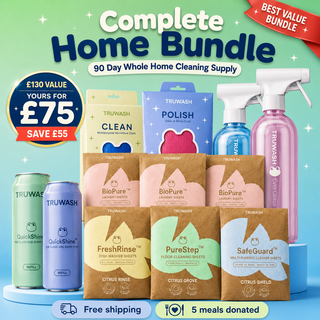
In the meantime: BioPure Laundry Sheets contain a built-in plant-based softener, which reduces detergent residue (one of the causes of static) before your clothes even reach the dryer. Pair with white vinegar in the rinse and a set of wool balls from any reputable seller, and you have a complete static-and-softening setup with no dryer sheets needed.
Frequently asked questions
Do wool dryer balls really work?
Yes — for reducing drying time (about 15–25% on full loads), softening cotton and towels, eliminating static on natural-fibre loads, and replacing single-use dryer sheets. They're less effective on heavy synthetic loads where they help but don't fully eliminate static.
How many wool dryer balls should I use?
Three for small loads, six for full loads. Adding more past six doesn't improve performance — it just adds weight for the motor to spin.
Do wool dryer balls reduce drying time?
Yes — in our testing about 15–25% on full cotton loads, slightly less on synthetics. The mechanism is mechanical separation (balls bounce between clothes, improving airflow) plus moisture buffering (wool absorbs and slowly releases water, evening out drum humidity).
Do wool dryer balls work for static?
For cotton and natural fibres, yes — almost completely eliminate static. For polyester, fleece and heavy synthetics, they help but don't fully fix it. Pair with white vinegar in the washing machine's rinse cycle and don't over-dry, and you'll get the full effect.
How long do wool dryer balls last?
3–5 years of weekly use before they noticeably compact. The “1,000 loads” marketing claim is best-case but roughly accurate for typical UK households. A re-fluff cycle (empty hot tumble with a damp cloth) every few months extends their life.
Are wool dryer balls better than dryer sheets?
On most metrics, yes — they last years instead of a single use, don't coat fabrics with the waxy residue that reduces towel absorbency over time, and have no synthetic fragrance or quaternary ammonium chloride to irritate sensitive skin. Dryer sheets do slightly better on heavy synthetic-load static specifically.
Can I add essential oil to wool dryer balls?
Yes — 3–5 drops on one ball every 5–10 loads gives a light natural scent without synthetic fragrance. Let the oil soak in for 10 minutes before tossing the ball into the dryer, otherwise it transfers as wet spots onto clothes.
Do plastic dryer balls work?
Less well than wool. Plastic dryer balls are noisier, shed microplastic, and aren't significantly cheaper. Wool is the right material — don't downgrade to plastic.
How do I clean wool dryer balls?
They don't really need cleaning — just run an empty hot tumble cycle with the balls and a slightly damp cloth every 3–6 months to refresh them. If they pick up pet hair or visible debris, a quick brush works.
Where can I buy wool dryer balls in the UK?
Lakeland, John Lewis, eco-friendly independent shops, and Amazon (filter for genuine 100% wool reviews). Expect £10–£15 for a set of 6. Avoid £25+ “premium” sets — the £10 ones from major UK retailers are the same wool quality.
Got a laundry question we haven't covered? Email us — family of three, no support script.


