


 Complete Your
Collection
Complete Your
Collection


 Secure Checkout
 30-Day Guarantee





Something happens every April. The clocks go forward, the light stretches further into the evening, and suddenly every cobweb and dusty skirting board demands attention. Spring cleaning isn't a modern invention — it's wired into us. But the way most of us clean our homes hasn't caught up with what we know about the chemicals we're washing into our water, our skin, and our children's lives.
This isn't a lecture. It's a practical, room-by-room spring cleaning checklist for UK homes — using natural, non-toxic cleaning products that actually work. We've built TruWash on the belief that you shouldn't have to choose between a clean home and a clean conscience. This guide is the checklist we use ourselves.
By the end, you'll have a clear plan, smart product swaps, and honest answers to the questions we get asked most. Let's get into it.
Why Switch to Natural Cleaning Products This Spring?
Most conventional cleaning sprays, detergents, and fabric conditioners are full of synthetic surfactants, artificial fragrances, and preservatives like methylisothiazolinone — a known skin sensitiser that's been restricted in rinse-off products across the EU since 2016. Yet it still turns up in plenty of cleaning products on UK shelves.
The average UK home uses over 60 litres of cleaning product a year. Much of that goes straight down the drain and into local waterways. Eco-friendly spring cleaning isn't about doing less — it's about choosing formulas that break down safely, come in less plastic, and don't leave a residue on the surfaces your family touches every day.
Here's what making the switch actually changes:
- Fewer harsh chemicals going down your sink and into local rivers
- Less single-use plastic in your recycling bin (or landfill, if we're being honest)
- Cleaner indoor air — synthetic fragrances are one of the main sources of indoor volatile organic compounds (VOCs)
- Skin that isn't stripped by aggressive surfactants on every wipe-down
The good news? Non-toxic cleaning products have come a very long way. You don't have to sacrifice clean for conscience any more.
Room-by-Room Eco Spring Cleaning Checklist
Work through each room in order. The ✦ symbol marks tasks where a product swap makes a meaningful difference.
Kitchen
- Clear worktops and wipe down with a natural multi-purpose spray ✦
- Degrease the hob and extractor filter with a bicarbonate of soda paste
- Descale the kettle with a 50/50 white vinegar and water solution
- Empty, wipe, and reorganise the fridge (remove all food; clean shelves with warm soapy water)
- Clean inside the oven with a bicarbonate and washing-up liquid paste — leave overnight, wipe off in the morning
- Wipe cabinet fronts and handles
- Sweep and mop the floor
Bathroom
- Scrub the toilet with a natural toilet cleaner or bicarbonate and vinegar
- Descale taps and the showerhead with white vinegar (soak in a bag secured with an elastic band)
- Clean grout lines with a paste of bicarbonate and water and an old toothbrush
- Wipe mirrors with a 50/50 water and white vinegar solution — streak-free, no paper towels needed
- Replace any nearly-empty plastic bottles with refills or solid alternatives ✦
- Wash the bath mat
Bedrooms
- Strip and wash all bedding — pillowcases, duvet covers, pillow protectors — on a 60°C cycle ✦
- Flip or rotate mattresses; vacuum the surface
- Wipe skirting boards, light switches, and door handles
- Clear under the bed
- Wash curtains or wipe down blinds
Living Room
- Dust all surfaces including behind the TV and along shelves
- Vacuum sofas and cushion crevices
- Wash removable sofa cushion covers ✦
- Wipe down light switches, remote controls, and cables
- Clean windows with a white vinegar solution and a microfibre cloth
Utility / Laundry Room
- Clean inside the washing machine drum (run an empty 60°C cycle with bicarbonate of soda in the drum)
- Wipe down the door seal and the detergent drawer — both collect mould
- Clear out old, half-used detergent bottles ✦
- Review what you're putting in every wash (see below)
✦ = a great place to make an eco swap. See the table further down for specific alternatives.
Tackling the Laundry Pile the Natural Way
Laundry is where most households have both the biggest environmental impact and the easiest wins. The average washing machine load uses around 50 litres of water, and whatever detergent you add goes into that water system entirely. Traditional liquid detergents come in heavy plastic bottles, are mostly water (you're paying to ship water around the country), and often contain synthetic brighteners and stabilisers that don't fully biodegrade.
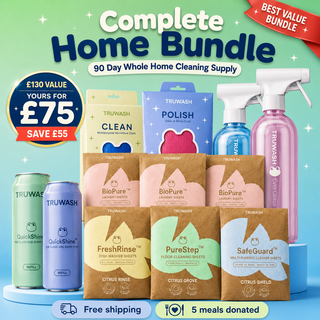
BioPure Laundry Sheets dissolve completely in the wash — no plastic drum, no measuring cap, no gloopy mess. Each sheet contains a concentrated, plant-derived formula that works in both cold and hot cycles, in standard and HE machines. One sheet per load; two for a heavily soiled wash. That's the entire instruction manual.
For your spring laundry blitz, work through in this order:
- Big items first — duvets, pillow protectors, curtains. These need the most time to dry.
- Bedding on 60°C to kill dust mites, which peak in winter when windows stay closed.
- Everyday clothes on 30°C — most modern eco detergents, including laundry sheets, are formulated to work effectively in cold water. Lower temperature means a lower energy bill.
- Air-dry where you can. Line drying is free, uses zero energy, and leaves clothes smelling genuinely fresh without synthetic fragrance.
Eco Swap Table: What to Replace This Spring
You don't need to overhaul everything on day one. Work through this list as products run out:
| What You're Using | Eco Swap | Why It's Better |
|---|---|---|
| Plastic bottle liquid detergent | BioPure Laundry Sheets | Zero plastic, no measuring, fully biodegradable plant-derived formula |
| Bleach-based bathroom cleaner | Bicarbonate of soda + white vinegar | Non-toxic, effective on limescale and soap scum, costs pennies |
| Aerosol furniture polish | Plant-based furniture cream or beeswax | No VOCs, no propellant gases, lasts longer |
| Synthetic fragrance plug-ins | Essential oil diffuser | Removes a significant source of indoor VOCs |
| Single-use plastic sponges | Compostable cellulose cloths | Biodegradable, often more absorbent, washable |
| Fabric conditioner | White vinegar in the rinse compartment | Softens naturally, removes detergent residue, no synthetic fragrance |
Your 5-Step Eco Spring Clean Action Plan
You don't have to overhaul everything at once. Here's a phased approach that won't overwhelm the weekend:
- Audit your cleaning cupboard. Pull everything out. Anything nearly empty gets replaced with an eco alternative when it runs out. Don't throw away what you already have — that's just more waste.
- Stock the natural staples. White vinegar, bicarbonate of soda, and a good washing-up liquid cover around 80% of household cleaning needs. Buy once, use for months.
- Swap your laundry routine. Switch to laundry sheets. It's the single easiest swap that removes the most plastic from your home in one go — no more cupboard full of half-used bottles.
- Go room by room. Use the checklist above. One room per session is more sustainable than trying to do the whole house in a day. You'll do a better job, and you'll actually finish.
- Build the habits. The spring clean is a reset. Set a quarterly reminder to do a lighter version of this list, and the next spring clean won't feel half as daunting.
The Verdict
Eco-friendly spring cleaning doesn't require specialist products, a bigger budget, or a perfect Sunday. It requires a slightly different shopping list and a willingness to read what's actually in the bottles you've always bought out of habit.
Natural cleaning products work. We've seen the test results, we've used them in our own home in Northern Ireland, and we've heard from thousands of customers who've made the switch without looking back. The spring clean is the perfect moment to start.
If you're going to make one change this spring, make it your laundry routine. BioPure Laundry Sheets are a good place to begin — 60 washes per pack, no plastic, no measuring, no fuss.
Frequently Asked Questions
Is eco-friendly spring cleaning actually effective?
Yes — with one caveat. "Eco" doesn't mean weak, but it does mean different chemistry. Plant-derived surfactants clean effectively; they just don't come with the theatrical foam or strong scent many people associate with "really clean". If you're switching from heavily fragranced conventional products, give it two or three weeks. Your sense of what clean smells like recalibrates quickly, and most people find they prefer it.
Can I use natural cleaning products on all surfaces?
Most natural cleaners are gentler on surfaces than conventional alternatives. The one to watch is white vinegar — it's acidic, so avoid it on natural stone (marble, granite) or unsealed grout, where it can cause etching over time. For stone surfaces, plain soap and water or a pH-neutral natural cleaner is the safer choice.
Are laundry sheets safe for sensitive skin?
BioPure Laundry Sheets are free from parabens, phosphates, optical brighteners, and synthetic fragrance — the four ingredients most commonly linked to skin reactions in laundry detergent. They're suitable for everyday family use on sensitive skin. For very young children's clothing, we recommend an extra rinse cycle as good practice, regardless of which detergent you use.
How do I descale my kettle without chemicals?
Fill the kettle halfway with a 50/50 mix of white vinegar and water. Bring to the boil, leave to soak for 30 minutes, then pour away and rinse twice with cold water. For stubborn scale, repeat and leave overnight. This works as well as commercial descalers and costs about 5p per treatment.
What's the best order to spring clean a room?
Top to bottom, back to front. Dust high shelves and light fittings first, then work down to surfaces, then floors last. Clean from the far corner of the room towards the door so you're not stepping back over areas you've already cleaned. Strip bedding before you vacuum — it releases a lot of dust.
How does plastic-free laundry compare on cost?
BioPure Laundry Sheets work out at around 25p per standard wash. A budget liquid detergent might come in slightly lower, but mid-range and premium brands typically sit at 30–50p per wash — and most still come in plastic that ends up in landfill. The switch to sheets saves money if you're currently buying anything above supermarket own-brand, and removes a significant plastic habit from your weekly shop.


